

Composite materials are widely used in restorative dentistry to repair damaged tooth structure while maintaining a natural-looking appearance. The choice between a conventional light-cured composite and a flowable composite depends on the restoration’s location, size and clinical requirements.
Light-Cured Composite
A light-cured restorative composite offers controlled placement and can be used for anterior and posterior restorations. Important characteristics may include:
- Natural shade matching
- Smooth handling
- High polishability
- Appropriate strength
- Wear resistance
- Easy placement
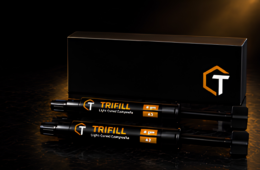
TRIFILL by TriDent is an aesthetic light-cured composite designed for natural shade matching and durable restorative applications. It provides smooth handling, high polishability and optimal strength. TRIFILL is available in A2 and A3 shades and is supplied in a 4 gm syringe.
Flowable Composite
A flowable composite has a lower-viscosity consistency that supports adaptation in areas where controlled flow is beneficial. It may be used for liners, small cavities and Class V restorations.
TRIFLOW is TriDent’s light-cured flowable composite. It offers excellent flow, effective adaptation, high polishability and radiopacity. It is available in A1, A2, A3, B1 and B2 shades.
Making the Appropriate Selection
A conventional composite can be selected when sculptability, strength and controlled placement are important. A flowable composite may be considered when adaptation and accessibility are key requirements.
Dental professionals should evaluate cavity classification, restoration location, shade requirements and the manufacturer’s instructions before selecting a restorative material.